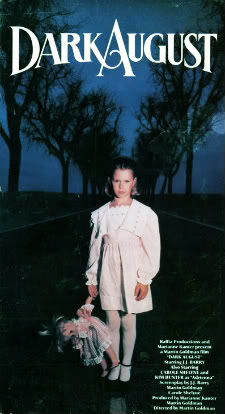
Dark August

darkaugust

Dark August (1976)

After accidentally running over a young girl, artist Sal Devito (J.J. Barry) is haunted by three things: visions of the tragic incident, a strange figure lurking in the woods, and by Old Man McDermitt , the girl’s grandfather. As Sal’s mind is slowly coming unglued, his girlfriend Jackie (Carolyne Barry) tries her best to stand by her man. Jackie’s friend recommends that Sal seek spiritual guidance from Adrianna (Kim Hunter), a witch who specializes in white magic. Adrianna discovers that someone has placed a curse on Sal which summoned a demon to torment him.

Director Martin Goldman takes a pretty big chance with his take on what a horror film should be. Without an effects budget or a high body count (this definitely ain’t no slasher film), he instead focuses on psychology, the performances of his actors, and the supernatural. But you’ll have to use your imagination here as almost nothing otherworldly is ever shown in Dark August to indicate that what’s happening is anywhere but in the minds of the characters. The score by William S. Fisher is a jazzy synth mishmash with some wacko drums and piano (so of course, I dig it). The workmanlike cinematography by Richard E. Brooks has a few surprises stashed in the film in the form of some gorgeously composed shots.

Unfortunately, the entire film hinges on Sal, a friggin’ unlikeable bastard. J.J. Barry (who co-wrote the film with Goldman and Carolyne Barry) turns in a great performance but his character is a selfish and smug douchebag. The only thing I liked about Sal’s character is that it doesn’t take him long to buy into the supernatural world around him. If this movie had taken an extra ten minutes he moronically vacillated between faith and science, I would have given up. Other members of the cast do a fine job but the script has them caught in a mire of banal melodrama. Dr. Zira herself, Kim Hunter, is great and she gets to spout some pretty crazy incantations during a seance which goes horribly awry.

Despite its “Me Generation” whining, ponderous pacing, and actors’ workshop vibe, I have to admit that there is something special about Dark August. On the surface it feels like Savage Weekend but without the trashiness or the chainsaw. It does have a very well staged and surprising moment of violence that I did not see coming. Another cool scenes is when we first see the dark figure that is always watching Sal, it is chilling. Sal tries to catch this presence by following it deeper and deeper into the woods and his demon stays just out of reach and is always seen in a blurry haze.

Also in the film’s favor: I watched Dark August after I burned my beat up Lightning Video tape to DVD-R. In my experience, this always lends a claustrophobic, anything-can-happen vibe to old rare films like this one. I highly doubt that this fairly obscure film will get the special treatment if it ever does make it to DVD. It’s a shame because even though Goldman’s film has some major strikes against it, I was left with a creepy feeling when it was over and a few things to think about. I can’t recommend Dark August too much because I don’t think horror film fans should go out of their way to find it. However, if this flick turns up on some 50 movie pack someday, patient folks should give it a spin.
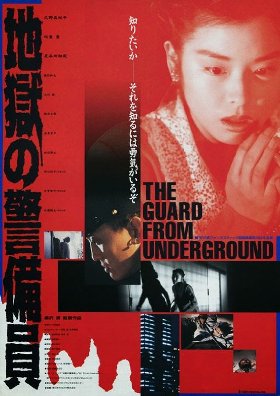
The Guard from Underground

guardfromunderground

The Guard from Underground (1992)

Akiko Narushima (Makiko Kuno) just started her new job in the art acquisition department of the Akebono Corporation and things couldn’t be weirder. The department doesn’t exist according to her unfriendly coworkers and the management is no help at all. Mr. Kurume (Ren Osugi), the head of her department, is a pervert and Mr. Hyodo (Hatsunori Hasegawa), the president, couldn’t be any more apathetic about running the company. To make matters worse, Fujimaru (Yutaka Matsushige), the security guard and ex-sumo wrestler, has gone berserk and is murdering Akebono employees one by one. Now locked inside the building, Akiko, Hyodo, and a handful of survivors must find a way to escape before they too become human pretzels in Fujimaru’s hands.

Kiyoshi Kurosawa (Cure, Pulse) writes and directs The Guard from Underground, an odd slasher potboiler with a pinch of comedy and a fistful of bizarreness tossed in. The film’s pace is quite deliberate; building the tension very slowly breaking only for dry humor and unexpected moments of extreme violence. Logic is not a strong point here and the plot does not hold up to very much scrutiny. The swirling score is quite odd and has a circus-like feel to it. Gore effects are mostly decent but some of the bone shattering moments look awkward and unrealistic. Luckily, the kill scenes here rely on brutality and not special effects wizardry.

Makiko Kuno plays Akiko, the heroine of the story, who senses something is wrong in the office building long before anyone else. Kuno is a pretty good actress (and maybe it’s a problem with the script) but it’s difficult to get much of an impression of her character in the film. The frighteningly talented Ren Osugi (MPD Psycho, Uzumaki) is very funny as the eccentric and perverted middle manager, Mr. Kurume. In his first film role, Yutaka Matsushige (Ringu, One Missed Call) makes for an imposing killer through menacing behavior and coolly delivered lines. Hatsunori Hasegawa (Gamera: Gaurdian of the Universe) plays Mr. Hyodo, the one person who seems thoroughly disinterested in running the company, quite well.

While The Guard from Underground may not make a great deal of sense and the pace isn’t exactly lightning fast, the film is moody and twisted enough to hold the attention of horror fans looking for something strange. Although nowhere near as violent or wild as something like Evil Dead Trap, it’s still interesting to see the Japanese take on the slasher formula with the seemingly unstoppable killer (Fujimaru) and the final girl (Akiko). The bleak and claustrophobic feel of the film is a sure sign of things to come from Kurosawa who later caused more than a few theater seat soilings with Pulse.

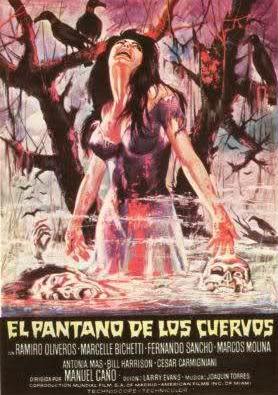
The Swamp of the Ravens

swampoftheravens

The Swamp of the Ravens (1974)

Dr. Frosta (Ramiro Oliveros) has been conducting illegal and immoral experiments on the recently deceased in an effort to conquer death and perfect the mental control of his subjects. All that Simone (Marcia Bichette), his estranged girlfriend, knows is that the doctor works too hard and doesn’t give her enough attention. The police inspector (played by Fernando Sancho) assigned to the case is getting closer and closer to catching and stopping Dr. Frosta. The obsessive doctor is pushed over the edge when Simone starts seeing another man and he decides to use her as his next test subject.

I was lead to The Swamp of the Ravens by this poster. Much like the video-store days of my youth, clever and beautifully morbid artwork have steered me wrong in the best way possible. While very, very far from obscure Spanish horror perfection, the film does deliver on the fog-enshrouded swamp and the ravens. Well, there are some ravens. Mostly, the swamp is populated by buzzards. Anyway, let’s get down to business.

The eerie mood and the sickening tone of this film communicate one thing: death is everywhere. I still can’t believe that director Manuel Caño is the same guy who brought us the inept and idiotic Voodoo Black Exorcist. He really outdoes himself here by taking a film with a lame, somewhat confusing, and tired plot and filling it with an atmosphere so heavy, it’s suffocating. A classic horror tale unfurling in a somnambulitic 70s haze? Oh, I’m already there, duder. Oh yeah, and that badass cinematography comes from Manuel Merino of Horror Rises from the Tomb and Vampyros Lesbos.

Most of the cast doesn’t do much for me but the intense Ramiro Oliveros (Cannibal Apocalypse, The Pyjama Girl Case) works as Dr. Frosta. And Fernando Sancho makes for a great police inspector who perfectly delivers some dark humor. Marcia Bichette is pretty good as Dr. Frosta’s imperiled girlfriend but only shines when it’s time for her to scream.

The film’s fiery finale would be more satisfying if the damn thing had ended there. I won’t give anything away but let me just say that the final wrap-up is completely awful. Instead of a horde of Dr. Frosta’s zombies going on a rampage we get something much, much cheaper. Oh well, can’t win ’em all! Another unfortunate misstep is that The Swamp of the Ravens has a pretty slow pace but I barely even noticed because this flick is so grim and so odd. What’s that? Necrophilia and a (supposedly) real autopsy? Now, you’ve got my attention!

“I don’t like buzzards. They are birds of death.”

The World’s Greatest Sinner

worldsgreatestsinner

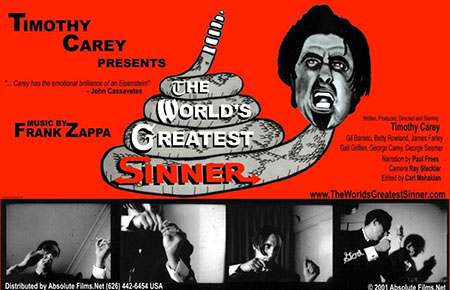
The World’s Greatest Sinner (1962)

In what is quite possibly the strangest rock and roll film ever made, Timothy Carey plays Clarence Hilliard, a man who wants to be God. He quits his job as an insurance agent to pursue his dream. By preaching the promise of eternal life on Earth and using the energy of rock and roll, Clarence slowly begins to become more and more popular. He even changes his name to God Hilliard which his followers are all too willing to call him. The devil sees great potential in this blasphemer and shows up as a PR man (played by James Farley) to steer God Hilliard towards a career in politics.

In this outrageous and very strange film which he wrote, directed, produced, and distributed, Timothy Carey ridicules the hypocrisy and megalomania of politicians, religious leaders, and rock stars. When Clarence delivers a speech about how every human being can be their own God while absentmindedly standing on a pile of fertilizer is a very telling moment about Carey’s intentions for this film. The odd soundtrack is provided by Frank Zappa who combines trashy rock and roll with outlandish library music producing excellent and unique results.

Like a cross between Elvis Presley and Jim Jones, Clarence Hilliard is a heretic, a demon, and an undulating rock and roll Beelzebub. The scenes where he wildly plays guitar with his band in a completely out of tune and off tempo fashion while the people go bonkers (even girls trying to rip his clothes off) are hilarious. Taking potshots at Elvis Presley and Jerry Lee Lewis, this film mocks celebrities and the people that worship them.

I have always been disturbed by legendary character actor Timothy Carey. I first noticed him in John Cassavete’s The Killing of a Chinese Bookie and his malignant presence always creeps me out. The guy looks like a walking corpse whose skin is falling off of his buzzard-like head. Even Carey’s voice has an unnatural ring to it as though it’s coming from a somewhere other than his mouth. The man is completely unhinged and his mind is boiling over with insanity yet there’s a dark intelligence underneath it all.

So I wasn’t surprised at all when I found out about this intelligent and wickedly sardonic film. The World’s Greatest Sinner is a fantastic cult film with hints of experimental editing and documentary-style direction (partially due to budget constraints) that is way ahead of its time. With all the subtlety of a sledgehammer made of dynamite, this is a deeply religious film that exposes human beings as the pathetic beasts that we are while at the same time questioning everything sacred.

“I’m not a preacher and I’m not drunk! I’m just a politician!”

Night of the Devils

nightofthedevils

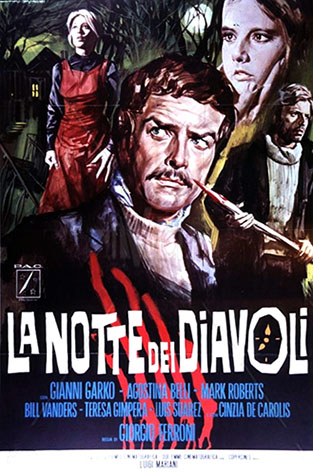
Night of the Devils (1972)

A man suffering from amnesia (Gianni Garko) staggers out of the woods, injured, and catatonic. He is brought to a hospital where a doctor (Umberto Raho) runs tests which determine the man has suffered a terrible shock that has reduced him to this agitated and paranoid state. The only person who can identify this man is Sdenka (Agostina Belli), a lovely young woman who claims she met the patient a just few days ago. She identifies him as Nicola, a business man from Italy, but then disappears after the very sight of her drives Nicola into a frenzy.

The film then flashes back to a few days before to the events that drove Nicola mad. While purchasing lumber for his company, Nicola’s car breaks down in the middle of nowhere and he seeks help from a family returning from a funeral and living in a nearly abandoned village in the woods. Jovan (played by Roberto Maldera) agrees to help Nicola but it must be in the morning because there is said to be a blood-drinking witch who prowls around at night. This turns out to be true when the patriarch Gorca (Bill Vanders) returns from attempting to kill the witch but is now a vampire himself. As each member of the family falls prey to vampiric forces, Nicola tries to rescue the lovely Sdenka, the lovely daughter of Gorca with whom he has fallen in love with.

Night of the Devils kicks in with one of the most attention-grabbing opening scenes in Italian horror. Gianni Garko (or Sartana to you spaghetti western types) comes stumbling out of the woods into a clearing. He passes out near a stream and wakes up in a hospital where he is being examined by doctors. During his tests, we see into his mind where he is tormented by horrific visions of rotting corpses, a woman’s face getting shot off, ghoulish figures ripping the flesh from a naked woman’s body. This sequence is spell-binding. Its cheesy for sure but it is impossible not to wonder just what happened to this guy. Curiosity = piqued? You know it.

Director Giorgio Feroni (Mill of the Stone Women) remakes the ‘Wurdulak’ segment of Mario Bava’s Black Sabbath but makes it his own by amping up the sex, the gore, and the cackling madness of the vampires. The soundtrack by Giorgio Gaslini (So Sweet, So Dead) is great with its haunting vocal pieces and tense and minimal freakouts. Spanish cinematographer, Manuel Berenguer, keeps things nice and claustrophobic. While the countryside is nice, it is never pretty. Instead, the entire film is very somber and cast in shadows (without being overly dark). When there is a brightly lit scene, it screams danger and madness. If I have to find faults with this flick then it would be that the pacing is a little slow and the gore effects are looking a bit gamy.

Oh, this cast is great. Gianni Garko is always good. The lovely Agostina Belli of Holocaust 2000 and Scream of the Demon Lover is excellent as the sweet (or possibly evil) Sdenka. You might remember Roberto Maldera from The Night Evelyn Came Out of the Grave where he played the very unlucky groundskeeper. The luscious and hypnotic Teresa Gimpera of Crypt of the Living Dead gets ripped to shreds in this one (and it’s not by the critics). The always dependable Umberto Raho who usually plays police inspectors gets to flash his skillz by playing a doctor! And then there’s Maria Monti as ‘The Witch’. This is a truly eerie performance from an underused actress who had a small role in What Have You Done to Solange? I also have to mention young Cinzia De Carolis who grew up and played the freaky jailbait who tries to seduce John Saxon in Cannibal Apocalypse.

Night of the Devils is one of those forgotten masterpieces and a genuinely gore-soaked relic. This is the kind of cinema that drives me nerdily on. This film proves that if you think you’ve seen every last scrap of Italian junk, chances are there is one more title out there you need to see. Creepy, sleazy, bloody, melodramatic, nasty, and, as an added bonus: mind-fucky! The somber tone never lets up for a second and you just know that this ain’t gonna end well for our deranged hero. This is good stuff, y’all.

“Television? Now that’s something I’ve never seen!”

Oasis of Fear

oasisoffear-poster

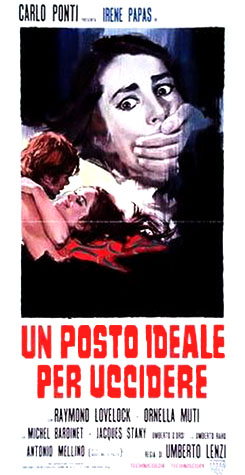
Oasis of Fear (1971)

Two British teenagers, Dick and Ingrid (played by Ray Lovelock and Ornella Muti), set out for Italy. The little scam artists sell porn and pictures of themselves posing nude to pay their way until they get busted and have 24 hours to get out of Italy. Instead of leaving immediately, they get robbed by some rather polite bikers and then get mistaken for a pair of German robbers. When they run out of gas, Dick and Ingrid stop at the house of Barbara Slater (Ingrid Papas), a bored (and strangely suspicious) housewife. The naive pair party with Barbara but soon discover her terrible secret.

Umberto Lenzi (Seven Blood Stained Orchids, Eyeball) does it again with Oasis of Fear, a sex obsessed and rebellious thriller. Though it’s a bit dated with all the hippie themes and some obvious symbolism, this is still a tense and fun film deftly directed by a real stalwart of Italian genre cinema. Oasis of Fear is edited by Eugenio Alabiso who cut many, many gialli including The Case of the Bloody Iris and The Fifth Cord. The score by Bruno Lauzi is a mix between awesome jazz and crappy generic hippie rock.

The cast totally rocks with the seductive and gorgeous Ornella Muti and the lovely but scheming Irene Papas (Don’t Torture a Duckling). Ray Lovelock is quite charming and believable as a desperate but overall good-natured conman. The always dependable Umberto Raho (The Night Evelyn Came Out of the Grave) shows up as a police inspector.

Oasis of Fear is a smart and excellently made giallo. It has its eye-rolling moments of hippie cheese but the grand design of the story is very cynical and intriguing. Lenzi could make some great thrillers and this one is no exception. I got a kick out of the parody of the Italian prudishness and Catholic guilt. The fact that these two kids can make a huge profit off of selling foreign smut to the squares is hilarious. Oasis of Fear is available on a Region 0 PAL DVD from Shameless Films. You should pick it up sometime. Go on, make Mr. Lenzi smile.

“Come on, Dick, kiss her. It’s in the stars.”

Plot of Fear

plotoffear-poster

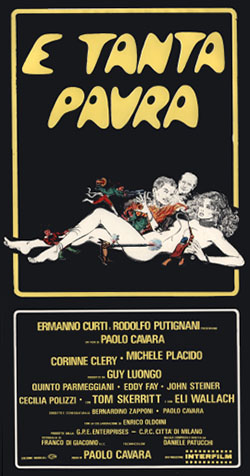
Plot of Fear (1976)

A sudden series of brutal homicides baffles police but the obsessive Inspector Gaspare Lomenzo (Michele Placido) is determined to catch the killer. The inspector also has to compete with Pietro Riccio (Eli Wallach), the head of a private detective agency who always seems to be one step ahead of his investigation. The only pattern for the crimes is that all of the victims were members of an exclusive sex club called The Fauna Lovers led by eccentric author Hoffmann (played by John Steiner). Inspector Lomenzo falls for Jeanne (Corinne Clery), a beautiful model who just happens to be involved with this club. She witnessed the accidental death of Rosa, a hooker who may be the key to cracking the case.

Paolo Cavara, you amaze me. After the excellent Black Belly of the Tarantula, director Cavara comes back with a vengeance with Plot of Fear. Whoa, dig that abrasive and frightening music score by Daniele Patucchi (Deep River Savages)! One has to assume that Patucchi is also responsible for those horrid disco numbers as well. Wow. The prolific cinematographer, Franco Di Giacomo, responsible for other Gialli such as Who Saw Her Die? and Four Flies on Grey Velvet, shines once again with his versatility. Whether it’s a gritty and hooker-filled police station or a fog-enshrouded stretch of highway, the man has a beautiful eye.

Michele Placido’s performance as Inspector Gaspare Lomenzo has instantly become one of my favorites in all of the Giallo genre. Lomenzo is hotheaded, high strung, egocentric, and yet is a totally brilliant detective. The beautiful Corinne Clery (Hitchhike, The Devil’s Honey) is excellent as Jeanne, the girl of questionable morals that Lomenzo falls for despite her involvement with the case. Eli Wallach (though hideously dubbed) is very good as the scheming and suspicious Pietro Riccio. An inexplicable American actor cameo in this film comes from Tom Skerritt (also dubbed) who does little more than wave his arms around in frustration. Last but not least, one of Italian genre flicks’ elite, John Steiner of Tenebre and Mario Bava’s Shock, delivers another fine performance.

Giallo fans will be quite pleased with this film as it has plenty of plot twists, a few brutal death scenes (immolation!), odious 70s fashion, garish set designs, beautiful ladies, sleazy sex, J&B sightings, and a slew of politically incorrect moments. Plot of Fear also sports a pretty dismal view of the world with its bleak snapshots of urban life and its rather sickening portrayal of the decadent wealthy. Sounds like fun, eh? Don’t worry, the addition of some dry comedy and a fast-paced, entertaining mystery keep this one from getting too serious.

“Criminals want to get caught. It’s a macabre invitation to a treasure hunt.”

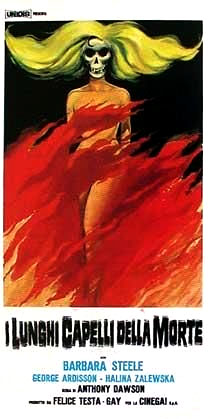
The Long Hair of Death

longhairofdeath

The Long Hair of Death (1964)

As noblemen, Count Humboldt and his son Kurt Humboldt (played by George Ardisson), burn a witch at the stake, she places a curse upon them. The witch’s daughter, Helen Karnstein (Barbara Steele), vows to make sure that curse is carried out but she is soon put to death. Her younger sister, Elizabeth (Halina Zalewska), survives and years later, is forced to marry Kurt Humboldt. One night, during a thunderstorm, Helen Karnstein’s grave is struck by lightning and a mysterious woman named Mary (also Barbara Steele) appears at the castle. Kurt is immediately smitten with Mary and takes her as a mistress not suspecting that she might have a little something to do with a certain curse that was placed upon him.

Director Antonio Margheriti, the man responsible for Castle of Blood, Seven Deaths in the Cat’s Eye, and Cannibal Apocalypse, brings us this gothic chiller. The plot isn’t anything spectacular and the dialogue is pretty standard. However, the ending ties everything together very nicely and the film’s atmosphere is pregnant with dread. Ah, I’ve always wanted to say that. I love the music score though it is pretty generic. Composer Carlo Rustichelli hits all the right cues with either the scary strings or the eerie organ. There’s also a bounty of excellent castle locations and detailed gothic sets which add to the creepy mood.

This film features more of that wonderful Italian cinematography that drives me absolutely bonkers (in a good way). The amazing Riccardo Pallottini (The Killer Must Kill Again, Massacre Time) lensed this one and I am astounded by his ability to create such stark compositions in black and white. The scene where Kurt Humboldt walks through the town square towards Elizabeth’s tomb is brilliantly framed and almost dizzyingly detailed. It reminds me of some of Joe D’Amato’s camerawork in Death Smiled at Murder.

Two lovely ladies, Barbara Steele and Halina Zalewska, lead the charge in this Italian goth-assault. As usual, Steele’s presence steels the show but Halina Zalewska is certainly no slouch. It’s a shame that Zalewska did little more than supporting roles for the rest of her career. When Steele, as Helen Karnstein, visits the spot where her mother was burned alive and raises a fistful of her ashes to the sky…Oh, I get chills. Then you got scenery-chomper, George Ardisson (Django Defies Sartana). Oh man, this guy is intense.

The Long Hair of Death has one major problem: it draaaaaaags in its middle section. A plague that strikes the kingdom and the machinations of the noblemen will stretch any attention span to the breaking point. The fine pacing of the first 40 minutes hits this lull and it takes a little while before the film’s climax lifts us out of the muck. On the plus side, keep an eye out for the really nasty looking corpse (shown in odious detail) and the not-so-subtly implied necrophilia. Aw yeah! Barbara Steele fans, if you enjoyed The Faceless Monster, The Ghost, or Terror Creatures from the Grave, you’ll dig on this one.

“She’s the cause of all our trouble. I curse the shrew that brought her into this castle of hell.”

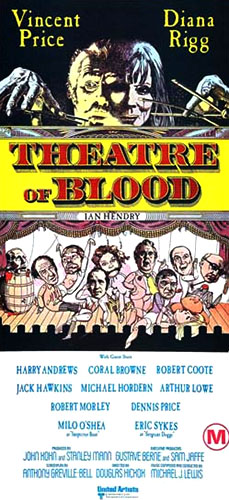
Theatre of Blood

theatreofblood

Theatre of Blood (1973)

Vincent Price plays Edward Lionheart, a Shakespearean actor whose failed career drove him to suicide. When he manages to survive, Lionheart uses the fact that the world thinks he is dead to return and seek revenge on the members of the circle of critics that gave him scathing reviews. As the members of the critic circle begin to drop dead in the manner of the great death scenes of Shakespeare, it is clear that Edward Lionheart is alive and well and must be stopped.

Douglas Hickox does a wonderful directing job on this fun horror film. The action flows like clockwork and keeps the viewers attention throughout. Wolfgang Suschitzky’s cinematography is excellent and he is able to sneak in some odd angles wherever he can in this mad movie. Even the set designs in the old theater that Lionheart hides out in are eye-catching. My only complaint of the film is an unnecessary fencing sequence featuring an obvious stunt double for Price.

The real star of this absolute blast of dark humor and Shakespearean horror is Vincent Price. He commands attention and delivers during all of his screen time. Price changes costume multiple times and manages to step in and out of different characters at the drop of a hat. His most impressive (and bizarre) scene comes when Lionheart washes up on a muddy riverbank after attempting to commit suicide and wakes up in a scene that plays out like the rebirth of his character.

The rest of the cast is perfect in their roles. The gorgeous and versatile Diana Rigg plays Edwina Lionheart, a woman loyal only to her father. Ian Hendry (Repulsion) plays Peregrine Devlin, the leader of the circle of critics. He keeps his part subtle, allowing the rest of the cast to go bonkers. Lionheart’s troupe of hobos is one of the most bizarre aspects of the cast. They follow his every command but manage to both mock and worship him whenever they can.

Theatre of Blood is an excellent horror film that can be enjoyed whether or not you’re a fan of Vincent Price. It is full of ironic death scenes, creative gore set pieces, dark comedy, and more Shakespearean references than you can shake a stick at. Price was quoted as saying this is his favorite of his film roles and it definitely shows. Also, if you ever wanted to see Price in an afro wig, then this is your movie.

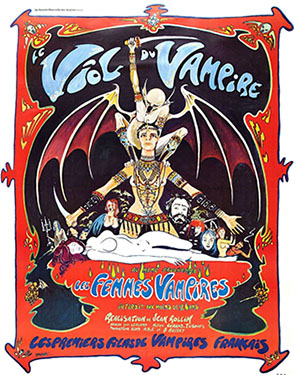
The Rape of the Vampire

rapeofthevampire

The Rape of the Vampire (1968)

A group of women who believe they are vampires are living in an old house on the outskirts of a small village. Three young people show up in order to prove to the ignorant villagers that these women are not vampires at all and their fears are unfounded. But things go very wrong when they actually turn out to be vampires and a bloody altercation with the villagers occurs. The queen of the vampires shows up and resurrects the slain vampires and attempts to have them join her fanged army bent on world domination.

The Rape of the Vampire is the first feature length film from Jean Rollin (The Demoniacs, Lips of Blood) and it isn’t exactly light viewing. My first encounter with this film was a total disaster and I barely managed to watch the entire thing. The fact that the film was originally a short film with the second half blatantly tacked on afterwards to make its feature length didn’t help matters much. Now that I have given many of the director’s other films a chance, coming back to The Rape of the Vampire was a much more pleasant, though somewhat problematic experience.

The first thing I noticed was the camerawork. It’s kind of shaky and clumsy at times but always hungry for beauty and able to capture the minutest details. The black and white compositions are simply breathtaking. After I got over drooling over the visual elements, the music tugged at my ear. The film’s score is a combination of free jazz, library music, and doomsayer organ pieces that perfectly accentuate this moody film.

While the film looses steam in the second half, it is hard for me to really slam it. This is an independent art horror film from the late 60s, what the hell was I expecting? Oh yeah, and it’s from France! The seams really start to show during some of the film’s violent moments as the actors come off as clunky and un-choreographed. There are a couple of fencing and sword fighting scenes that are pretty embarrassing to watch. How seriously all of this is meant to be taken is anybody’s guess. I found a lot of comedy hidden in here that takes some of the edge off all the pretension.

I’m glad I returned to this Rollin film after having such a negative reaction to it the first time around. I still get antsy during the second half but the poetic ending saves the day. If you’re a horror fan curious about getting into Jean Rollin then this is absolutely the last film you should start with. For that, try my favorites The Grapes of Death or The Living Dead Girl. If you’ve got a thing for artsy vampire films that emphasize mood and revel in experimentation then you’ll pretty much flip the fuck out for The Rape of the Vampire.

“Crazy people always have a nasty effect on me.”